

DECODER

Clinician Resources

Designed by clinicians for clinicians, the Decoder report functions as a Decision Support Tool to decode the patient’s complex biopsychosocial history and flag potential missed pathology, medication errors, and modifiable lifestyle factors. 

What is Decoder?

Decoder is four-page report populated with patient information transmitted directly to your software – just like a specialist letter.

  • The information is securely collected from the patient via online questionnaire and compiled into the Decoder report using proprietary custom software.   
  • Each report is the same format, the information differs between patients.
  • NO artificial intelligence is involved: the template is coded with logic based on five years of guideline research and specialist consultation. All data handling complies with Australian Digital Safety Standards and Privacy Act.
  • Designed to be used in series, Decoder Reports are automatically issued in an annual cycle at 0, 6 and 12 months.   

Remember the OSKE exam format? The clinical history was provided before the patient interaction, allowing you to organise your thoughts and conduct the consultation deliberately and time-effectively. Remove the stress of being assessed, add in helpful hints, and you have Decoder!

A Comprehensive Dataset at Your Fingertips

DECODER’s data set contains national benchmarking (ePPOC) plus a rich biopsychosocial dataset collected via a suite of validated tools as outlined below:

Pain History

  • Pain diagnosis, duration, body map
  • Red flags – saddle anaesthesia, night pain
  • Pain severity (BPI)
  • Neuropathic pain (PainDETECT)
  • Catastrophising (PCS)
  • Multidisciplinary team engagement
  • Tests and interventions
  • Self-Efficacy (PSEQ)
  • Impact on employment and productivity
  • Support at home
  • Interference on ADLs/Falls (BPI)

Medication history utilising CAPS-2 database

  • Prescription
  • Supplements
  • Cannabis 
  • Opiates (oMEDD)
  • Flagging to exclude harmful polypharmacy and prescribing concerns
  • Analgesia risk score (COMM-9)

Demographic

  • postcode 
  • gender, sex, 
  • ATSI
  • Funding Category eg DVA
Medical history
  • Full bio-psycho-surgical history
  • Red flag symptoms: including weight loss, night sweats, saddle paraesthesia
  • Orange flag symptoms: psychological
  • Yellow flag symptoms: including incontinence, hypoglycaemia, dyspnoea
  • Biometrics
Lifestyle History
  • Exercise type, frequency and duration
  • Kinesophobia (TAMPA)
  • Sleep duration and quality (ISI)
  • OSA screening and treatment compliance
  • Eating style and attitudes
  • Disordered eating screening (SCOFF)
  • Dietary quality (Nutrition score)
  • Substances including nicotine, cannabis and alcohol
  • Sensory barriers (hearing, vision, communication)
Patients’ goals and unspoken concerns

Providing Unique Decision Support

The report includes customised flagging based on the patient’s pain and medical history, guiding clinicians to adhere to best practices and optimise management. 

These flags include:

Red flags designed to prompt consideration for potential missed diagnosis and pharmacy morbidity,

Orange flags of potential confounding psychiatric conditions

Yellow flags of potential lifestyle and social barriers to improved pain management.

Ease of Navigation

We understand doctors manage persistent pain patients at various management stages and have established approaches to navigating these consults. 

For this reason, we have designed a Decoder that – much like a Swiss army knife – can be used in part or its entirety, depending on the clinical context

The four-page Decoder report has four key sections:

Click images to expand and hover on red dots for more infos

Click on red circle for more infos

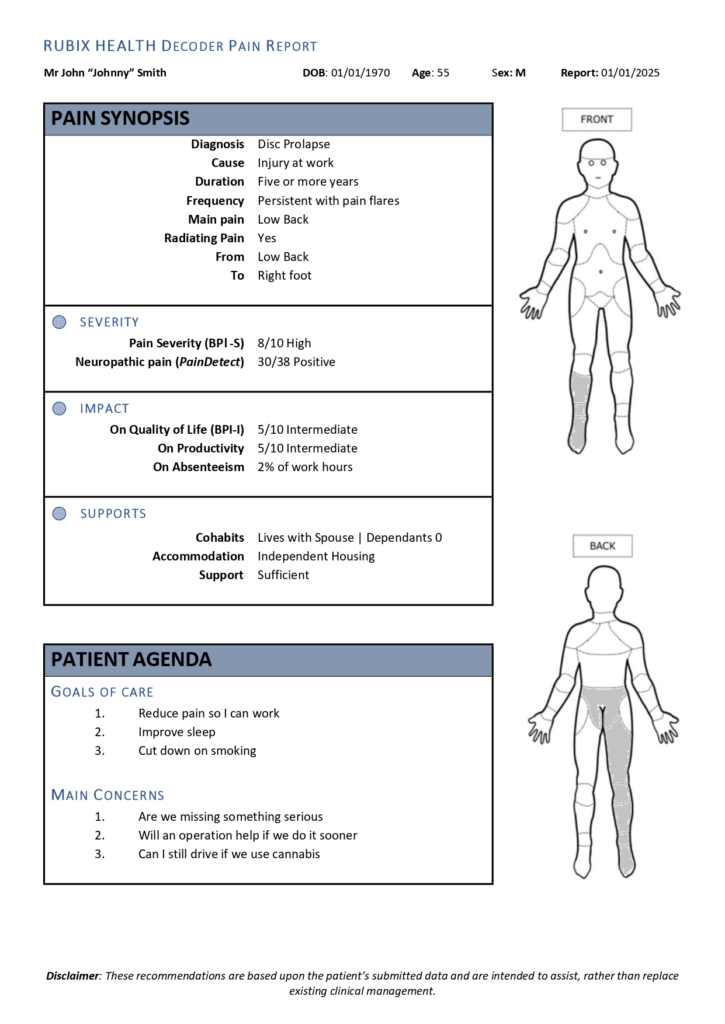
Page 1: Pain Synopsis
with Patient Agenda
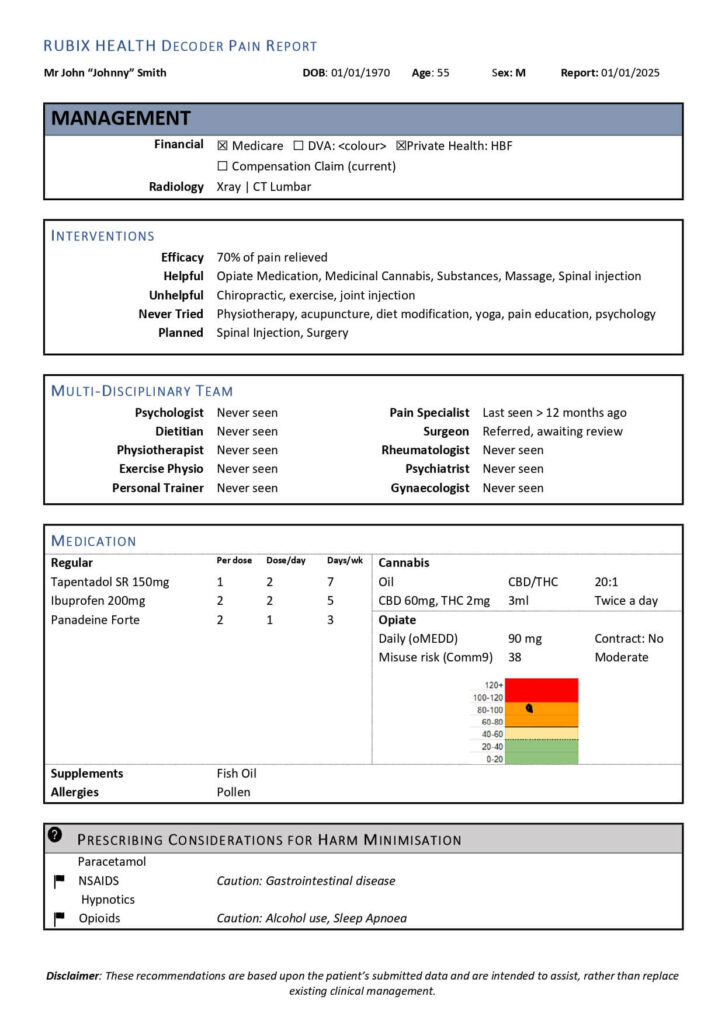
Page 2: Management
with Prescribing Flags
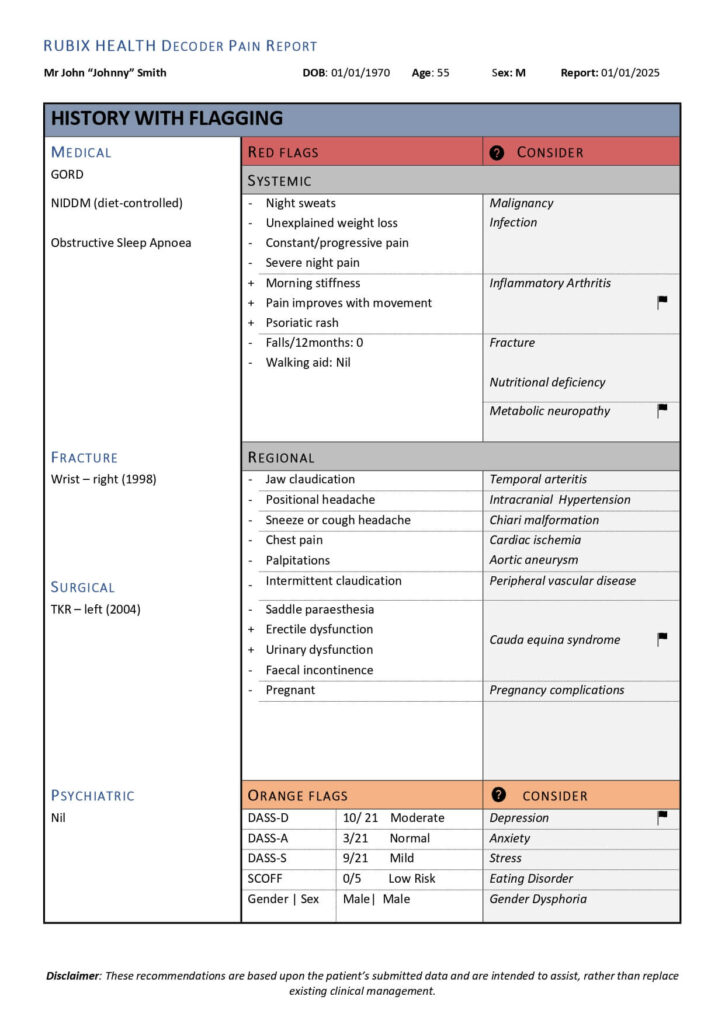
Page 3: Bio-Psych History with Red and Orange Flags
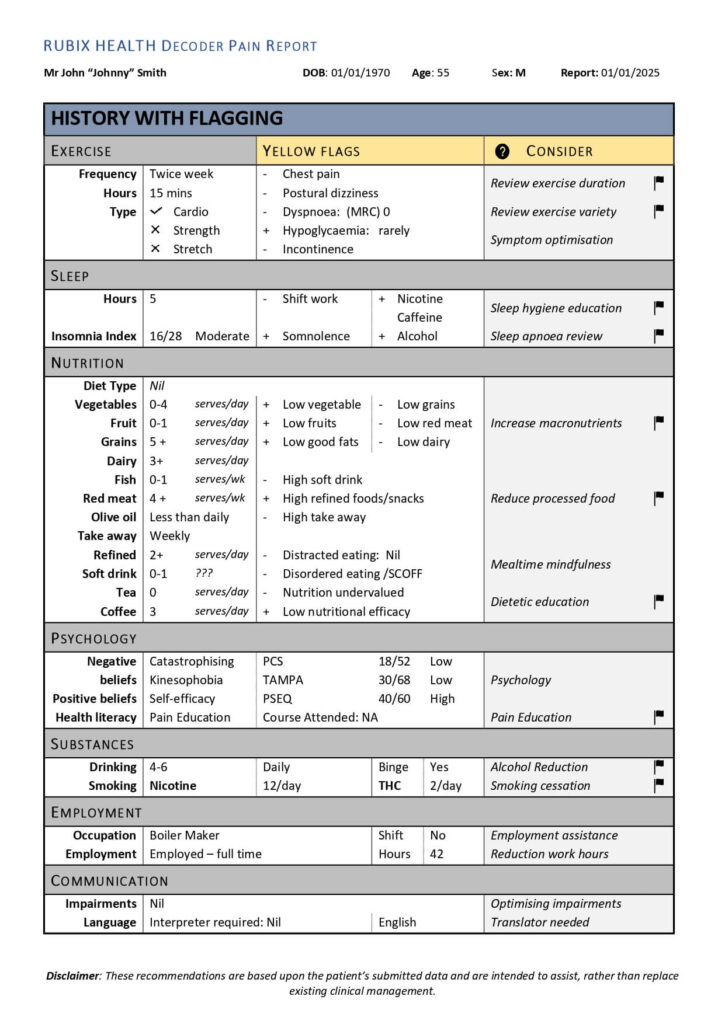
Page 4: Lifestyle-Social History with Yellow Flags
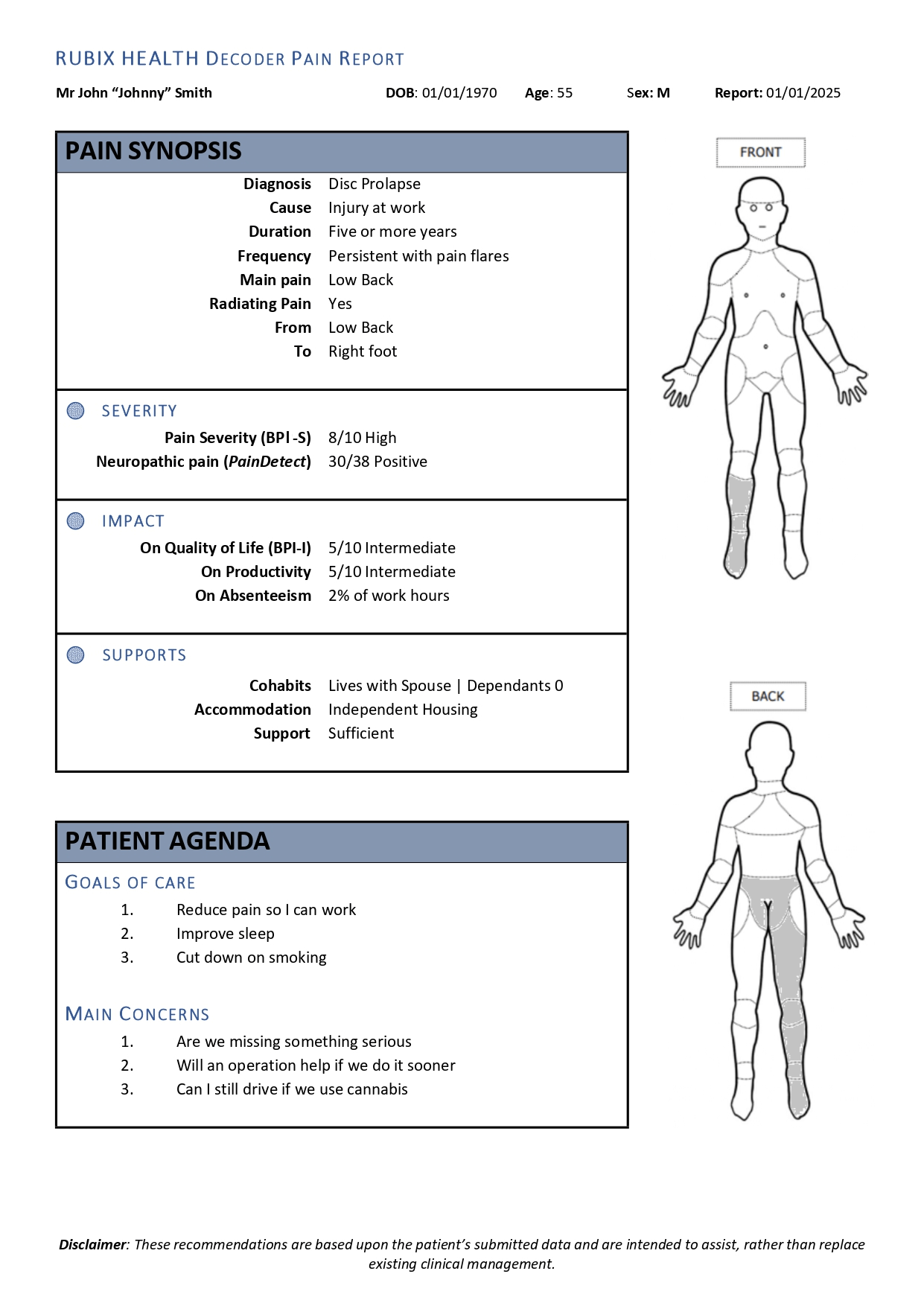
Page 1 Decoder
Brief Pain Inventory - Severity Score measures the intensity of a person's pain on a scale, typically assessing worst, least, average, and current pain levels.
Pain Detect - Neuropathic Pain Score quantifies the likelihood of neuropathic pain based on patient-reported symptoms and characteristics.
Brief Pain Inventory - Interference Score evaluates how pain impacts daily functioning across areas like mood, work, and social activities.
Productivity - A self-rated score out of ten assessing the extent to which pain affects productivity.
Absenteeism - The percentage of scheduled work hours missed in the preceding seven days due to pain.
Support - A patient-rated evaluation of the adequacy of their current support levels.
Page 1: Pain Synopsis with Patient Agenda
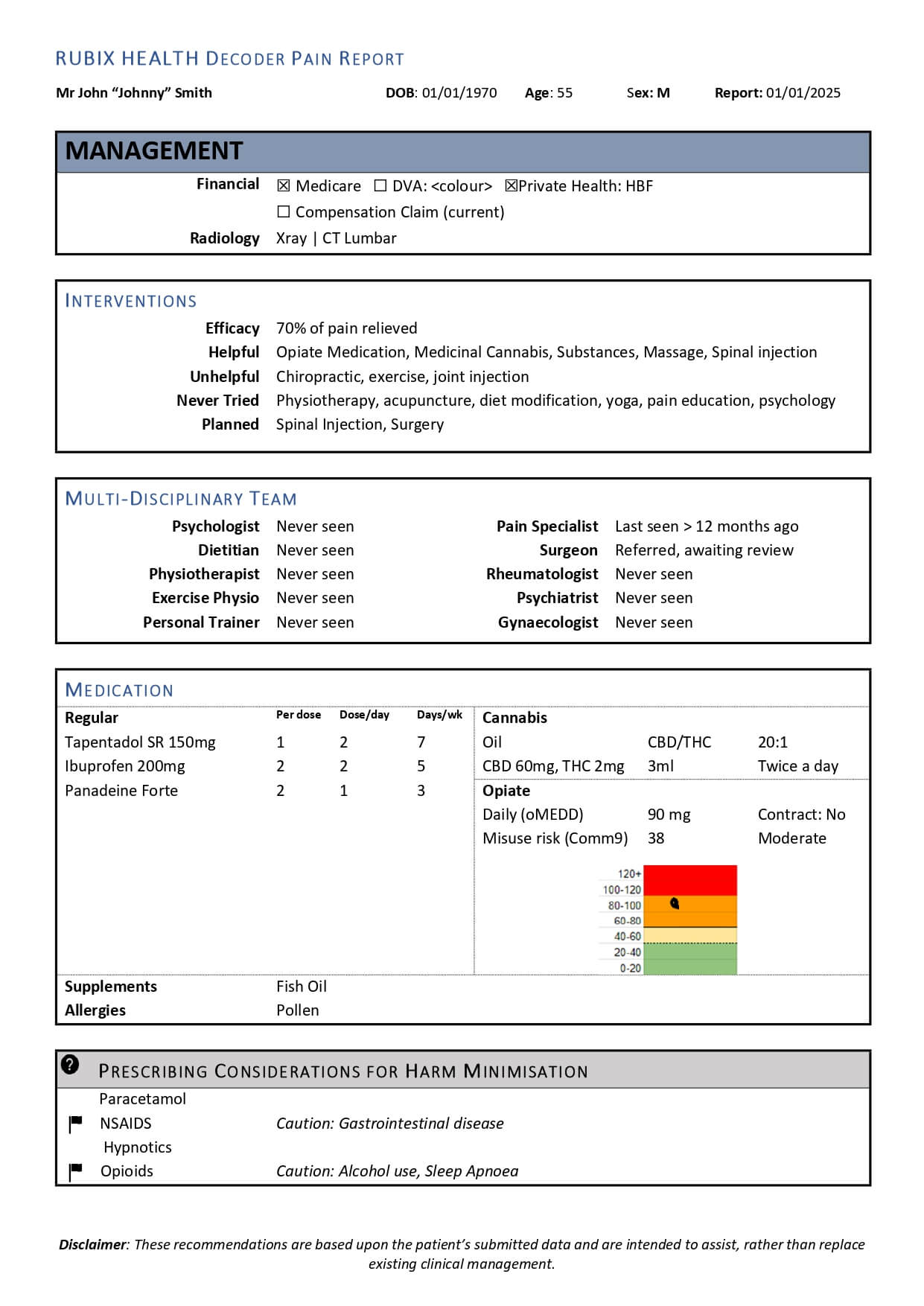
Page 2 Decoder
OMEDD stands for Oral Morphine Equivalent Daily Dose, a standardised measure used to compare the potency of different opioids by converting their doses into an equivalent dose of oral morphine.
Contract - Indicating the presence or absence of a current opioid contract.
The COMM-9 Score screens for potential opioid misuse in patients with chronic pain, based on self-reported behaviours.
Prescribing Flags - are tailored to stated medications and co-morbidities, cautioning the clinician to review stated conditions.
Page 2: Management with Prescribing Flags
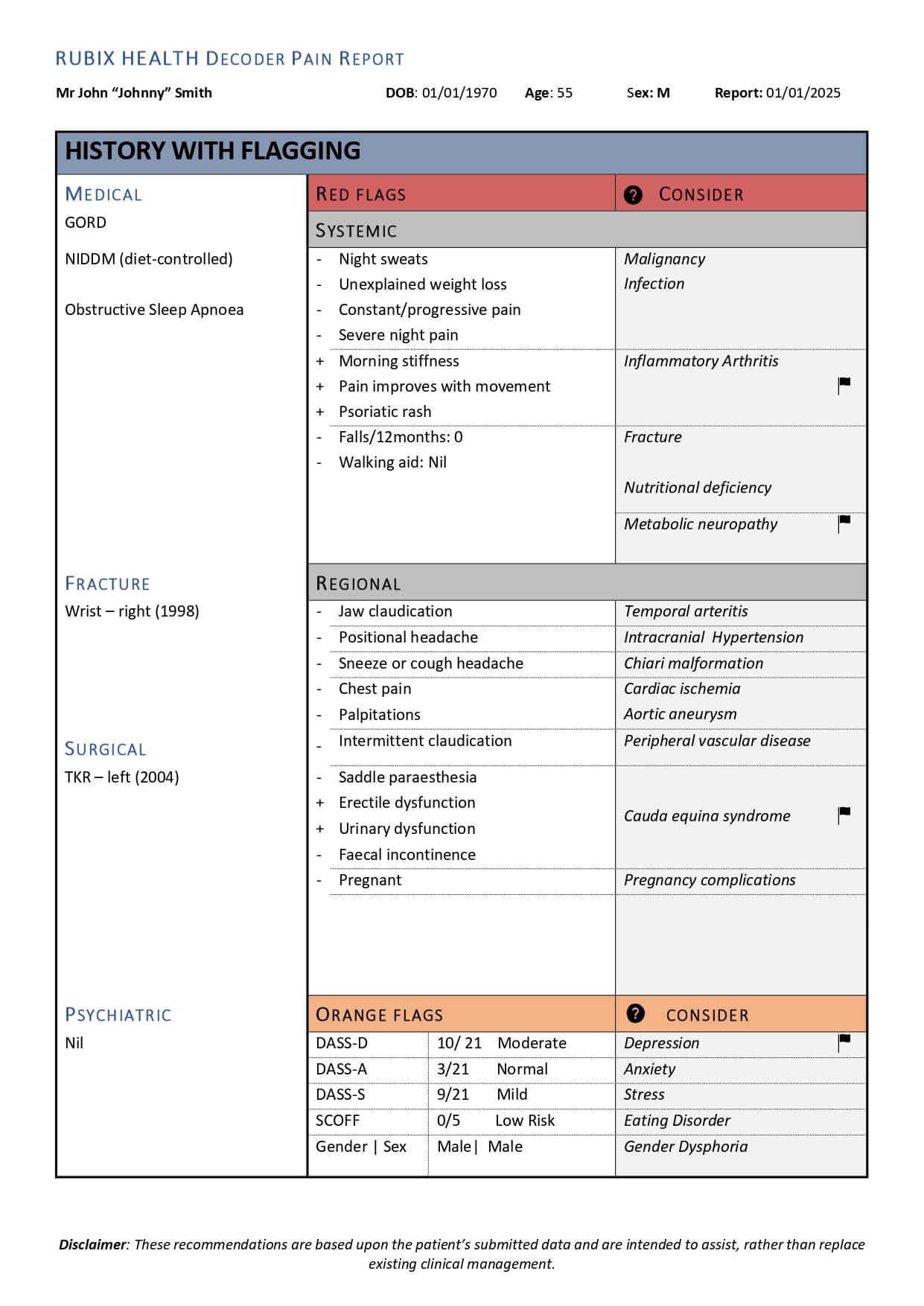
Page 3 Decoder
Red flag symptoms are notarised as positive or negative (+ / - ) depending on patient responses.
Red Flags are displayed depending on pain patterns, symptoms reported and co-morbidities. They are intended to guide the clinician to potential serious or missed diagnoses.
The DASS-21 (Depression, Anxiety, and Stress Scales-21) measures the severity of depression, anxiety, and stress through a 21-item self-report questionnaire.
Orange Flags are displayed depending on symptoms, gender, sex and co-morbidities. They are intended to guide the clinician to potential confounding psychological barriers to improve pain management..
The SCOFF Score is a screening tool used to identify individuals at risk of eating disorders.
This item is flagged if Gender does not equal Sex. This is not a diagnosis of Gender Dysphoria. It is intended to prompt the clinician to consider the impact of a patients sexuality on their pain experience.
Page 3: Bio-Psych History with Red and Orange Flags
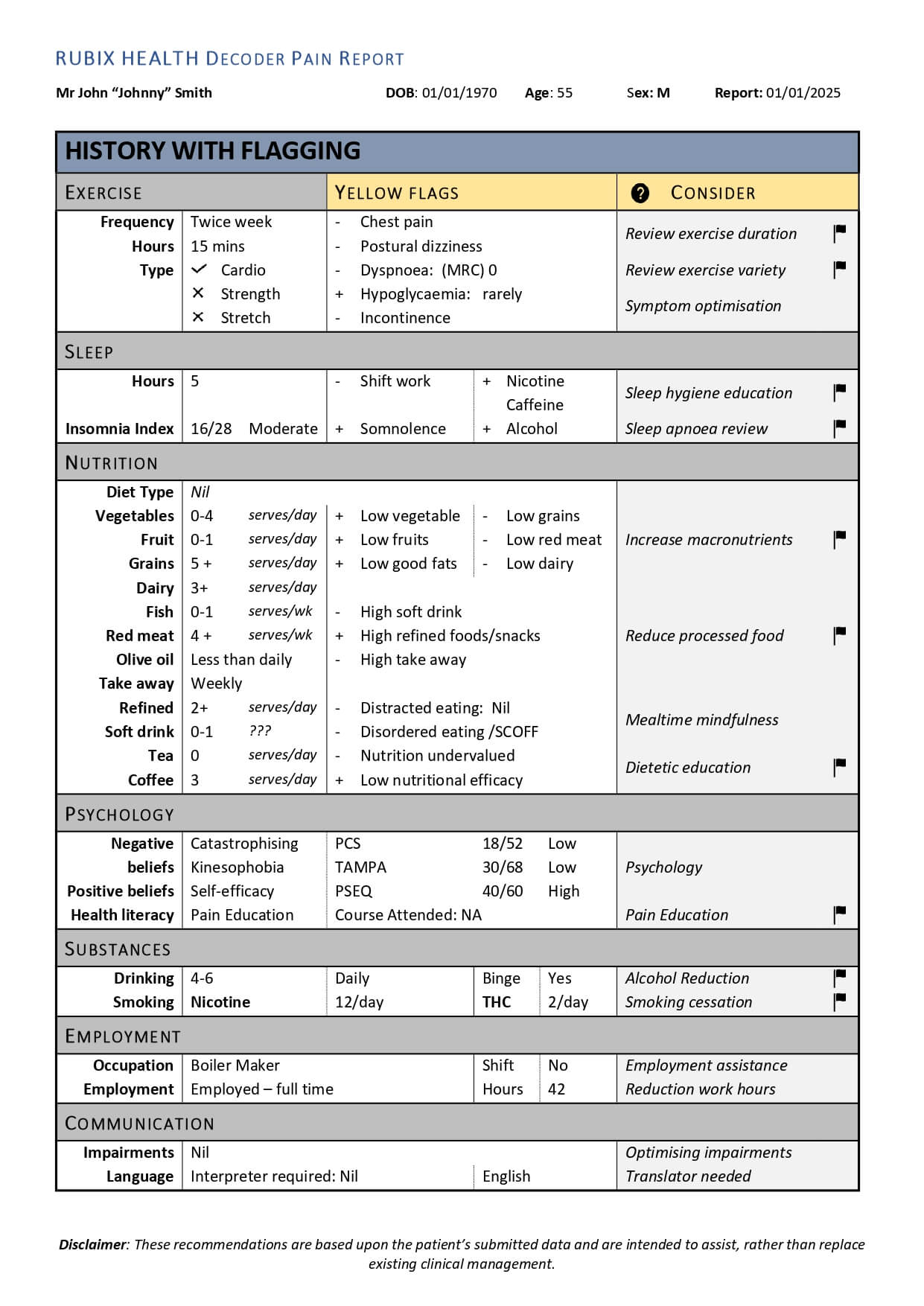
Page 4 Decoder
Yellow Flags refer to psychosocial factors, such as beliefs, emotions, and behaviours, that may increase the risk of developing chronic pain or complicate recovery. Custom flags appear depending on reported symptoms and behaviours.
Symptoms that potential;y function as barriers to achieving optimal Yellow flag symptoms are notarised as positive or negative, depending on patient responses.
The Pain Catastrophising Score (PCS) measures the extent of negative thoughts and feelings related to pain, such as helplessness and rumination. Higher scores are linked with increased pain intensity, greater disability, emotional distress and poorer treatment outcomes.
The TAMPA Scale of Kinesophobia valuates fear of movement or re-injury. Higher TAMPA scores are linked to increased fear-avoidance behaviours, reduced physical functioning, and long-term disability in persistent pain conditions.
The Pain Self-Efficacy Questionnaire (PSEQ) is a 10-item self-report tool designed to assess the confidence individuals with persistent pain have in performing daily activities despite their pain. Higher PSEQ scores are associated with better pain management, increased physical functioning, and reduced disability in individuals with persistent pain.
Shift Work: Yes or No

Page 4: Lifestyle-Social History with Yellow Flags

New Patient?

Skim front to back to gain an overview and mentally flag areas that require prioritisation (ie red flags, inadequate support, patient concerns)

Existing Patient?

Focus on the elements of patient history you require greater clarity on (ie. yellow modifiable lifestyle factors, orange psychological barriers, prescribing review or multi-disciplinary team status)

Decoder is Especially Helpful with:

Decoder’s persistent pain blueprint is a powerful antidote to the overwhelm caused by the sheer volume of information clinicians and patients must navigate within consultative time pressures.

Reporting Criteria

What is HealthLink? HealthLink is an Australian IT network that securely transmits health information between medical organisations. If you are unsure if you are registered to receive documents via HealthLink, speak with your practice manager or contact HealthLink on 1800 125 036 or visit www.healthlink.com.au

Rubix Health Icon

Accessing Decoder for Your Patients

An annual cycle of Decoder reports can be ordered through our website. 
Reporting is patient-funded or Unique Subscription Tokens can be purchased and offered to your patients for redemption.

Note: Practitioner account registration with Rubix Heath is required.

What is HealthLink? HealthLink is an Australian IT network that securely transmits health information between medical organisations. If you are unsure if you are registered to receive documents via HealthLink, speak with your practice manager or contact HealthLink on 1800 125 036 or visit www.healthlink.com.au

Page 4 Decoder
Yellow Flags refer to psychosocial factors, such as beliefs, emotions, and behaviours, that may increase the risk of developing chronic pain or complicate recovery. Custom flags appear depending on reported symptoms and behaviours.
Symptoms that potential;y function as barriers to achieving optimal Yellow flag symptoms are notarised as positive or negative, depending on patient responses.
The Pain Catastrophising Score (PCS) measures the extent of negative thoughts and feelings related to pain, such as helplessness and rumination. Higher scores are linked with increased pain intensity, greater disability, emotional distress and poorer treatment outcomes.
The TAMPA Scale of Kinesophobia valuates fear of movement or re-injury. Higher TAMPA scores are linked to increased fear-avoidance behaviours, reduced physical functioning, and long-term disability in persistent pain conditions.
The Pain Self-Efficacy Questionnaire (PSEQ) is a 10-item self-report tool designed to assess the confidence individuals with persistent pain have in performing daily activities despite their pain. Higher PSEQ scores are associated with better pain management, increased physical functioning, and reduced disability in individuals with persistent pain.
Shift Work: Yes or No

Page 3 Decoder
Red flag symptoms are notarised as positive or negative (+ / - ) depending on patient responses.
Red Flags are displayed depending on pain patterns, symptoms reported and co-morbidities. They are intended to guide the clinician to potential serious or missed diagnoses.
The DASS-21 (Depression, Anxiety, and Stress Scales-21) measures the severity of depression, anxiety, and stress through a 21-item self-report questionnaire.
Orange Flags are displayed depending on symptoms, gender, sex and co-morbidities. They are intended to guide the clinician to potential confounding psychological barriers to improve pain management..
The SCOFF Score is a screening tool used to identify individuals at risk of eating disorders.
This item is flagged if Gender does not equal Sex. This is not a diagnosis of Gender Dysphoria. It is intended to prompt the clinician to consider the impact of a patients sexuality on their pain experience.

Page 2 Decoder
OMEDD stands for Oral Morphine Equivalent Daily Dose, a standardised measure used to compare the potency of different opioids by converting their doses into an equivalent dose of oral morphine.
Contract - Indicating the presence or absence of a current opioid contract.
The COMM-9 Score screens for potential opioid misuse in patients with chronic pain, based on self-reported behaviours.
Prescribing Flags - are tailored to stated medications and co-morbidities, cautioning the clinician to review stated conditions.

Page 1 Decoder
Brief Pain Inventory - Severity Score measures the intensity of a person's pain on a scale, typically assessing worst, least, average, and current pain levels.
Pain Detect - Neuropathic Pain Score quantifies the likelihood of neuropathic pain based on patient-reported symptoms and characteristics.
Brief Pain Inventory - Interference Score evaluates how pain impacts daily functioning across areas like mood, work, and social activities.
Productivity - A self-rated score out of ten assessing the extent to which pain affects productivity.
Absenteeism - The percentage of scheduled work hours missed in the preceding seven days due to pain.
Support - A patient-rated evaluation of the adequacy of their current support levels.